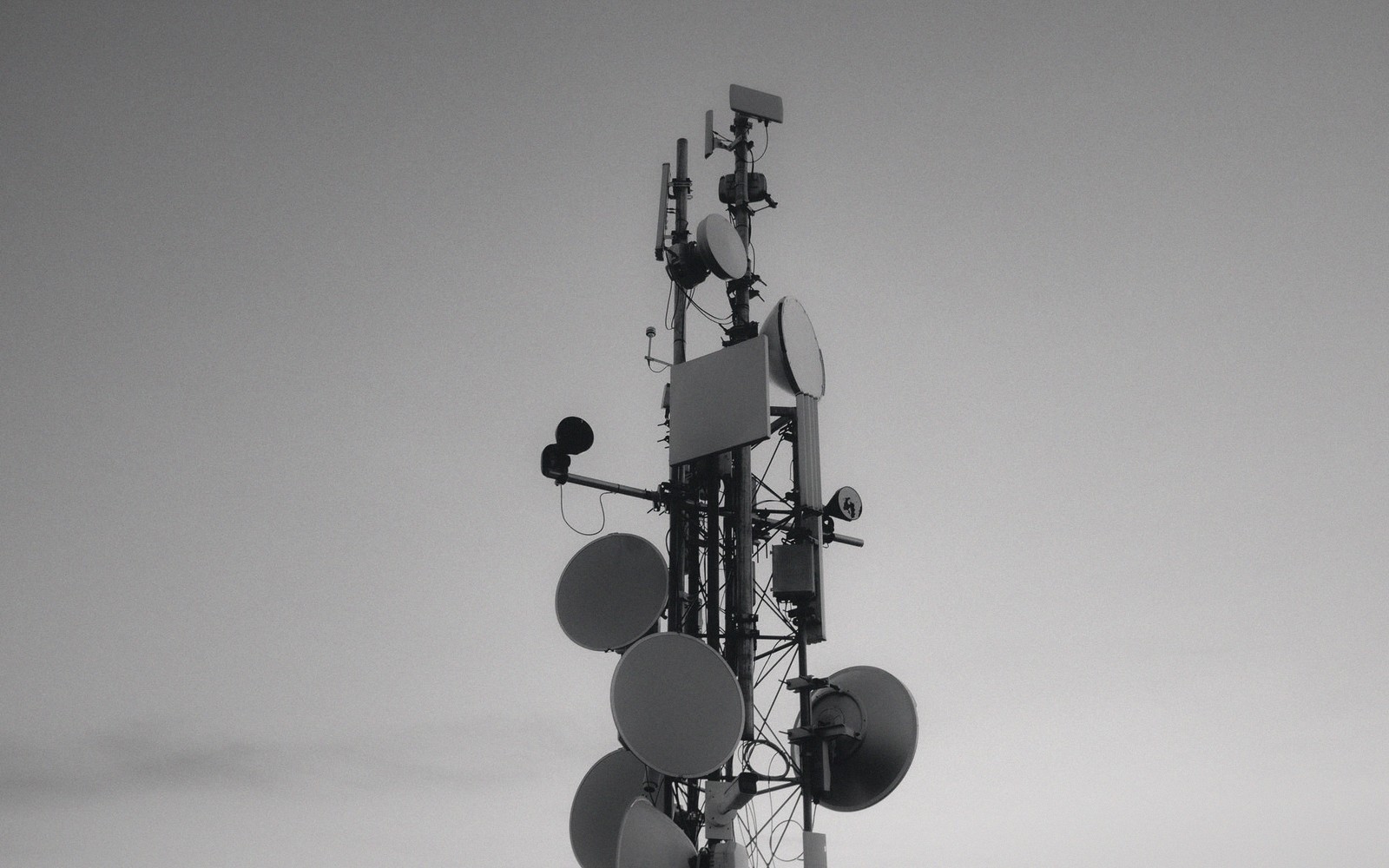
A single powerful transmitter covering a whole city sounds efficient, but it isn't. Every conversation would need its own slice of spectrum, and because the transmitter is loud enough to reach everywhere, no frequency can be reused until you are far enough away that co-channel interference fades below the noise floor. In practice, a single-transmitter system is a spectrum dead end.
The cellular insight, developed at Bell Labs in the late 1940s and turned into a deployable system over the following decades, inverts the logic. Instead of one loud transmitter, you deploy many low-power ones, each covering a small area — a cell. Because each transmitter only needs to reach the edge of its own cell, its power at the edge of a neighbouring cell is weak enough that the same frequencies can be recycled a relatively short distance away. The spectrum multiplies.
The geometry textbook reaches for the hexagon because hexagons tile a plane without gaps or overlaps, and their shape approximates the roughly circular coverage footprint of an omnidirectional antenna. Real cells are never hexagons — terrain, buildings and antenna patterns make them irregular blobs — but the hexagonal diagram is a useful abstraction for reasoning about frequency reuse patterns.
01Reuse Distance and the Cluster
The key design variable is the reuse distance: how far apart two cells must be before the same frequency block can be reused without causing unacceptable interference. It depends on the path-loss exponent of the environment (urban or suburban, open or obstructed) and on the acceptable carrier-to-interference ratio for the modulation scheme in use.
Early analogue systems grouped cells into reuse clusters — typically seven cells, each assigned a different frequency block, after which the pattern repeated. A seven-cell cluster means each frequency is used in roughly one-seventh of cells at any moment, which is a modest spectral efficiency. GSM used a similar approach. Later digital systems, especially CDMA-based ones, broke from this model: because each user is separated by a unique spreading code rather than a distinct frequency, every cell can use the same carrier frequency simultaneously. The interference budget is managed statistically rather than geographically. cdmaOne (IS-95), a 2G system, was the first wide deployment of this universal frequency reuse, and UMTS (3G) carried it forward.
LTE and 5G NR push further. With sophisticated multi-antenna techniques, tight power control and interference coordination between neighbouring base stations, these systems can operate with frequency reuse of one — every cell uses all available spectrum — while managing co-channel interference through scheduling and beamforming rather than geographic separation.
Done well, it is imperceptible; done poorly, it produces an audible click or a dropped call.
From this piece
02What Happens When You Move
A handover (or handoff, in North American usage) is the process of transferring an active connection from one cell to another without dropping the call or session. It sounds simple; the engineering is not.
The classic mechanism is hard handover: the terminal drops its connection to the source base station and immediately picks it up with the target. For a fraction of a second, neither link is active. Done well, it is imperceptible; done poorly, it produces an audible click or a dropped call. GSM uses hard handover, orchestrated by the network: the handset measures signal strength on neighbouring cells, reports those measurements upward, and the network decides when and where to hand over.
UMTS introduced soft handover, exploiting the fact that all cells share the same frequency. A terminal at the edge of two cells can simultaneously decode signals from both base stations, and both can simultaneously decode the terminal. The network's Radio Network Controller combines the duplicate streams coherently — the stronger one wins, moment to moment. The result is a smoother transition but at the cost of consuming radio resources at two base stations concurrently.
LTE reverts to hard handover, relying instead on improved scheduling and faster execution to keep the interruption brief. The handset measures reference signals on adjacent cells, and the source base station uses the X2 interface — a direct link between adjacent base stations — to coordinate the handover without routing the decision through a centralised controller. This reduces latency and makes the process faster.
5G NR adds conditional handover, in which the source cell pre-programmes a set of handover conditions into the device. When one of those conditions is met — signal on the target cell crosses a threshold — the device executes the handover immediately, without waiting for a round trip of signalling. In fast-moving scenarios, this small timing advantage meaningfully reduces interruptions.
03Why It Matters
None of this is invisible infrastructure detail. Cell size, reuse distance and handover rate determine how much spectrum a network can squeeze from a fixed allocation, how reliably it serves fast-moving users, and how gracefully it handles the edge cases — the motorway junction, the tunnel exit, the packed stadium where cells shrink to tens of metres. The cellular architecture is the reason a city of millions can share a few hundred megahertz and nobody thinks of it as a scarce resource.
LTE reverts to hard handover, relying instead on improved scheduling and faster execution to keep the interruption brief.
From this piece