
A radio carrier, by itself, carries nothing useful. It is a pure sine wave at a fixed frequency: regular, predictable and empty. The act of modulation imposes variation on that wave — deliberate, controlled change that a receiver can read back as information. Without it, a transmitter is a tone generator. With it, the carrier becomes a transport.
A sine wave has exactly three things you can vary: amplitude (how tall the peaks are), frequency (how rapidly it oscillates), and phase (where in its cycle it sits at a given moment). Every modulation scheme exploits one or more of these handles. The simplest — amplitude modulation, AM — presses the audio waveform directly onto the carrier's height. Early broadcast radio used exactly this. It works, but the amplitude of a received signal varies with distance and multipath reflections, so AM is fragile: the channel interferes directly with the dimension carrying the data.
Frequency modulation, FM, is sturdier. Instead of varying height, the signal shifts the carrier frequency up or down in proportion to the audio level. Because most interference attacks amplitude rather than frequency, FM has a natural immunity to the kind of noise that plagues AM. That robustness — not superior fidelity — is the real reason FM displaced AM for broadcast and analogue two-way radio. TETRA, the digital trunked standard used by emergency services, uses π/4-DQPSK, a digital phase-modulation scheme, for its radio channels.
Phase modulation closes the set. Shift the carrier's phase at defined moments, and a receiver that knows what phase transitions to expect can read those shifts as bits. Binary phase-shift keying (BPSK) uses two phase states — 0° and 180° — giving one bit per symbol. Quadrature phase-shift keying (QPSK) uses four states — 0°, 90°, 180°, 270° — packing two bits per symbol at the same symbol rate. The symbol rate (baud) is set by bandwidth; the bits-per-symbol is set by the modulation order. Increasing the order is how engineers extract more data from the same slice of spectrum.
01Order, Noise and the Inevitable Trade-off
Extend the logic: 16-QAM arranges sixteen constellation points in a four-by-four grid in the complex plane, encoding four bits per symbol. 64-QAM encodes six. 256-QAM encodes eight. 1024-QAM — used in 5G NR under good conditions — encodes ten bits per symbol. With each step up in order, spectral efficiency climbs, but the constellation points move closer together. The receiver must distinguish finer and finer differences in amplitude and phase, which demands a better signal-to-noise ratio. Push too hard and errors multiply faster than the extra bits are worth.
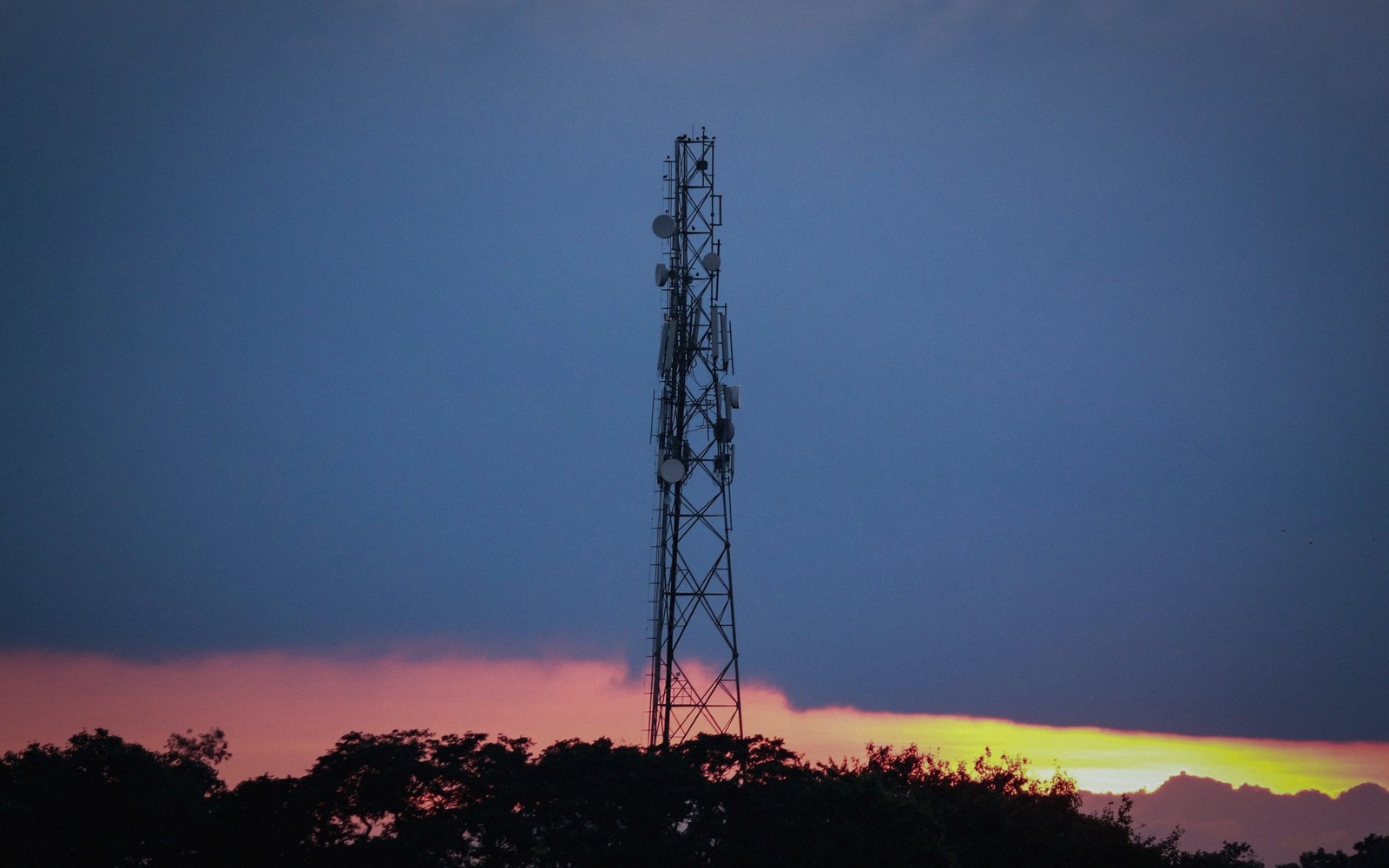
This is not a design flaw; it is a law of physics restated as engineering policy. Claude Shannon's channel capacity theorem says the maximum information rate depends on bandwidth and signal-to-noise ratio together. Modulation order is the dial that trades robustness for efficiency, and every system has to choose where to sit — or, better, choose dynamically. Modern cellular networks do exactly that: the base station and device continuously measure channel quality and negotiate the modulation scheme in real time, a process called adaptive modulation and coding (AMC). A device close to a well-sited mast may run at 256-QAM. The same device at the cell edge may drop to QPSK to maintain a working link at all. The relationship between noise floor and link performance sets the practical ceiling for whichever scheme is in use.
Critical-communications systems, by contrast, often hold a more conservative modulation — deliberately. A TETRA terminal at the edge of coverage needs a reliable voice path, not a theoretically optimal throughput. Trading spectral efficiency for robustness is a deliberate design choice when the application is emergency services, not video streaming.
Because most interference attacks amplitude rather than frequency, FM has a natural immunity to the kind of noise that plagues AM.
From this piece
02OFDM: Spreading the Load
Modern wideband systems add another layer of complexity. Orthogonal frequency-division multiplexing (OFDM) splits a wide channel into hundreds or thousands of narrow subcarriers, each modulated independently — typically with QAM. The subcarriers are spaced so that each one's spectral peak falls exactly on the nulls of its neighbours, letting them coexist without interference despite near-total overlap. The result is a system that is robust against multipath fading (each narrow subcarrier sees a nearly flat channel), easy to equalise, and flexible enough to assign different subcarrier groups to different users. LTE and 5G NR are both built on OFDM foundations; so is Wi-Fi.
The subcarrier spacing in 5G NR is configurable — 15 kHz, 30 kHz, 60 kHz and higher — to suit different deployment scenarios from wide-area macro cells to millimetre-wave short-range links. On each subcarrier, the modulation scheme chosen is still fundamentally a QAM constellation; OFDM is the vessel, QAM is what fills it.
Modulation, then, is not one decision but a layered set: which waveform property to vary, how many states to use, how to organise the carriers, and how to adapt all of this to conditions that change second by second. Every setting is a negotiation between the physics of the channel, the demands of the application, and the spectrum available.
The same device at the cell edge may drop to QPSK to maintain a working link at all.
From this piece